Find Light Meter for Industrial, Agricultural, and Environmental Uses
Source 30 verified light meter models from Chinese manufacturers. Compare specifications like measurement range, accuracy, and power supply to select the right device for industrial, agricultural, or environmental applications.
Key considerations
Products List








Comprehensive Sourcing Guide
Strategic Sourcing Guide for Industrial and Agricultural Light Meters
The global market for light meters has expanded significantly, driven by the dual demands of industrial precision and agricultural optimization. For procurement professionals, sourcing these devices requires a nuanced understanding of the specific measurement parameters, environmental durability, and compliance frameworks that distinguish high-performance instruments from generic consumer tools. This guide synthesizes available product data to provide a disciplined framework for evaluating suppliers and selecting the appropriate technology for your operational needs.
Technical Specifications and Measurement Capabilities
When evaluating light meters, the primary differentiator is the specific parameter being measured and the sensor technology employed. The product landscape includes distinct categories such as Visual Light Meters, Photoelectric Light Meters, and specialized Quantum PAR Meters. Each serves a unique function within the broader spectrum of illumination analysis.
Visual light meters, often utilized for general environmental monitoring, typically measure illuminance and environment temperature. These devices operate with a sampling rate of approximately two times per second, providing real-time data for dynamic environments. The measurement range for these units can extend up to 200,000 lux, with a resolution as fine as 0.1 lux, allowing for precise adjustments in lighting setups. Accuracy is a critical metric; observed specifications indicate a tolerance of 3% of the reading plus 10 digits, which is a standard benchmark for professional-grade instruments in this category.
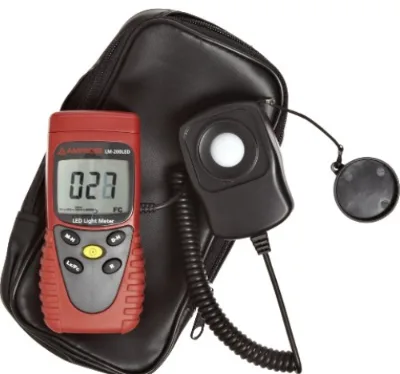
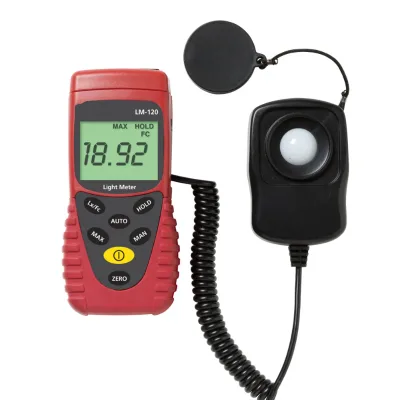
For applications requiring biological or horticultural data, Quantum PAR Meters offer a specialized function. These devices are designed to measure photosynthetically active radiation, a critical factor in plant growth. Key characteristics for these units include high accuracy, data logging capabilities, and a large measurement range. The physical construction often involves ABS or plastic materials, with dimensions varying from compact handheld sizes to larger units with external probes. For instance, some models feature an external probe position to isolate the sensor from the main body, ensuring that the user's shadow or body heat does not interfere with the reading.
Power supply configurations also vary significantly across the product range. While some units rely on standard 1.5V AA alkaline batteries, others may utilize 1.2V rechargeable options or internal battery systems designated as 5# or AAA. Procurement teams must verify the specific power requirements of the selected model, as battery availability and longevity directly impact operational continuity in remote or field-based applications.
Compliance and Certification Verification
In the B2B procurement of electronic measuring instruments, compliance with international safety and environmental standards is non-negotiable. The data indicates a prevalence of CE certification, which signifies conformity with health, safety, and environmental protection standards for products sold within the European Economic Area. Additionally, RoHS (Restriction of Hazardous Substances) compliance is frequently observed, ensuring that the electronic components do not contain restricted hazardous materials such as lead, mercury, or cadmium.
Beyond safety certifications, quality management systems play a vital role in supplier selection. ISO certification is a key indicator of a manufacturer's commitment to consistent quality control processes. Buyers should explicitly request proof of current ISO certification status, as this validates the supplier's ability to maintain product consistency over time.
It is important to note that while certifications like CE and ISO are common, they are not universal guarantees for every listed product. Procurement teams must verify the specific certification status of the exact model being purchased. Furthermore, physical standards such as protection levels (e.g., IP41) indicate the degree of protection against solid objects and water ingress. An IP41 rating suggests protection against solid objects larger than 1mm and dripping water, which is suitable for indoor or sheltered environments but may require additional casing for harsh outdoor conditions.
Cost Drivers and Pricing Dynamics
The pricing structure for light meters is influenced by a complex interplay of technical specifications, build quality, and supply chain factors. The observed market range spans from approximately $1.12 to $3,000 USD, reflecting the vast diversity in product capabilities. Entry-level models, often simple visual light meters with basic functionality, occupy the lower end of the spectrum. In contrast, high-end Quantum PAR Meters with data logging, high accuracy, and specialized sensors command premium prices.
Several factors drive these cost variations. First, the sensor technology itself is a major cost component. Geiger counter sensors or specialized photodiodes used in high-accuracy models are more expensive to manufacture than standard photoelectric sensors. Second, the inclusion of advanced features such as data logging, large measurement ranges, and high-resolution displays adds to the unit cost. Third, the packaging and accessories, such as carrying bags or gift box packaging, contribute to the final price point.
Minimum Order Quantity (MOQ) is another critical cost driver. The observed MOQ range spans from 1 unit to 500 units. Buyers seeking small quantities may face higher per-unit costs due to the lack of economies of scale, while bulk purchasers can negotiate more favorable pricing tiers. Understanding the relationship between volume and price is essential for budgeting and inventory planning.
Typical Applications and Use Cases
The versatility of light meters allows them to serve a wide array of industries. In the agricultural sector, Quantum PAR Meters are indispensable for optimizing crop yields. By measuring the specific light spectrum required for photosynthesis, farmers can adjust greenhouse lighting or assess outdoor shading conditions to maximize plant growth. The data logging feature in these meters allows for long-term trend analysis, helping agronomists correlate light exposure with harvest quality.
In industrial and commercial settings, Visual and Photoelectric Light Meters are used for quality control and safety compliance. Facilities such as manufacturing plants, warehouses, and office spaces must adhere to specific illuminance standards to ensure worker safety and productivity. The ability to measure illuminance with high resolution (0.1 lux) allows facility managers to identify dark spots and optimize lighting layouts. Additionally, the measurement of environment temperature alongside light levels can be crucial for processes sensitive to thermal conditions.
Research and development laboratories also rely on these instruments for precise calibration and testing. The high accuracy (3% Rdg ± 10dgts) and external probe options make these devices suitable for controlled experiments where environmental variables must be strictly monitored. The compact dimensions of many models, such as those measuring 153x65x30mm or 118x70x29mm, facilitate portability for field testing and on-site diagnostics.
Supplier Evaluation and Origin Analysis
When evaluating potential suppliers, geographic origin and manufacturing capabilities are significant indicators of product quality and supply chain reliability. The data highlights two primary manufacturing hubs: Qingdao, Shandong Province, and Shenzhen, China. Shenzhen is renowned for its electronics manufacturing ecosystem, often associated with high-tech components and rapid prototyping capabilities. Qingdao, while also a major industrial center, may offer different logistical advantages depending on the specific supply chain requirements.
Buyers should assess the supplier's ability to provide customization. The availability of customization options suggests a flexible manufacturing process capable of adapting to specific client needs, such as branding, packaging, or minor technical modifications. However, the extent of these customizations should be clearly defined in the procurement agreement to avoid scope creep.
The warranty period is another critical factor in supplier evaluation. Observed warranty terms range from one year to two years. A longer warranty period often reflects the manufacturer's confidence in the durability and reliability of their product. It also provides the buyer with greater protection against early-life failures. Buyers should verify the terms of the warranty, including what is covered (e.g., manufacturing defects vs. accidental damage) and the process for claiming service.
Quality Control and Long-Term Procurement Considerations
Ensuring consistent quality requires a robust quality control strategy. Buyers should request detailed specifications regarding the materials used, such as ABS or plastic, and verify the physical dimensions and weight of the units. For example, a weight of approximately 194 grams (without battery) indicates a portable design, but the actual weight may vary depending on the battery type and packaging.
Long-term procurement considerations extend beyond the initial purchase. The availability of spare parts, such as batteries and probes, is crucial for maintaining operational continuity. The standardization of components, such as the use of common battery types (AA, AAA), simplifies the logistics of replacement parts. Additionally, the after-sales service, including the one-year guarantee mentioned in several product profiles, should be evaluated for responsiveness and coverage.
To mitigate risks, buyers should implement a phased testing protocol. Before committing to a large order, purchase a sample unit to verify the claimed specifications, including accuracy, sampling rate, and protection level. This empirical testing ensures that the product meets the specific requirements of the intended application. Furthermore, maintaining a relationship with the supplier for ongoing support and updates is essential, especially for devices that may require firmware updates or calibration adjustments over time.
Comparative Analysis of Product Attributes
To facilitate decision-making, the following table summarizes key attributes observed across different product models. This comparison highlights the diversity in specifications and helps buyers identify the most suitable option for their specific needs.
| Attribute | Model A (UV340B) | Model B (YW-552) | Model C (LX1010B) | Model D (APM130) |
|---|---|---|---|---|
| Type | Visual Light Meter | Photoelectric Light Meter | Photoelectric Light Meter | Quantum PAR Meter |
| Certification | CE | ISO | CE, RoHS | CE |
| Origin | Qingdao, China | Shenzhen, China | China | China |
| Accuracy | N/A | 3% Rdg ± 10dgts | N/A | High Accurate |
| Measurement | Illuminance, Temp | Illuminance | 0~200000 lux | Ppfd Meter |
| Resolution | N/A | N/A | 0.1 lux | Large Range |
| Battery | N/A | 2x AA / 2x 1.2V | N/A | AAA |
| Warranty | 1 Year | 1 Year | 1 Year | 2 Years |
| Material | ABS | N/A | Plastic | Plastic |
| Dimensions | 45mm (Sensor) | 153x65x30mm | 118x70x29mm | 120x91.2x27mm |
| Protection | IP41 | N/A | N/A | N/A |
This table illustrates that while many models share common origins and basic certifications, the specific application requirements dictate the choice of model. For instance, the Quantum PAR Meter (Model D) stands out with its specialized function and extended warranty, making it ideal for agricultural applications. Conversely, the Photoelectric Light Meter (Model B) offers high accuracy and a specific measurement range suitable for industrial lighting audits.
In conclusion, sourcing light meters requires a meticulous approach that balances technical specifications, compliance requirements, and cost considerations. By leveraging the detailed product attributes and understanding the nuances of the market, procurement professionals can make informed decisions that ensure operational efficiency and long-term value. The key lies in aligning the specific capabilities of the selected instrument with the precise demands of the application, while maintaining rigorous standards for quality and supplier reliability.
FAQs
What certifications do light meters typically have?
Most light meters carry CE certification for European safety compliance. Some models also include RoHS compliance to restrict hazardous substances, while others hold ISO certification for quality management system verification.
How accurate are photoelectric light meters?
Professional photoelectric light meters often achieve an accuracy of 3% of the reading plus 10 digits. This tolerance level ensures reliable measurements for industrial quality control and environmental monitoring applications.
Can I customize light meter packaging or branding?
Customization is available for many light meter models to meet specific client needs. Buyers can request tailored packaging options such as gift boxes with carrying bags or standard cartons depending on the supplier.
What is the warranty period for these devices?
Warranty terms typically range from one year to two years for light meter units. A longer warranty period often indicates manufacturer confidence in product durability and reliability for long-term operational use.
Which battery types power these light meters?
Power supply configurations vary, with some units using 1.5V AA alkaline batteries. Other models may utilize 1.2V rechargeable options or internal battery systems designated as 5# or AAA for portability.
How do I find light meters with external probes?
Look for models specifying an external probe position to isolate the sensor from the main body. This feature prevents interference from user shadows or body heat during precise measurement tasks.